
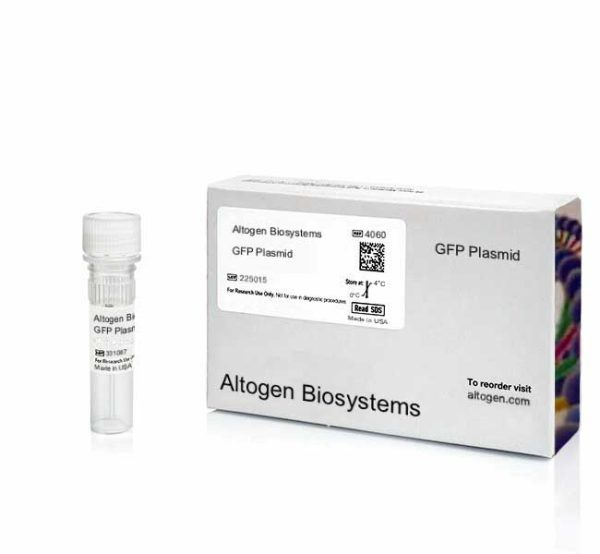
GFP-expressing plasmid DNA (25 µg)
Product Overview
GFP-expressing plasmid DNA is a powerful molecular tool widely used in cell biology, molecular cloning, transfection optimization, and real-time visualization of cellular processes. The plasmid contains a gene encoding green fluorescent protein (GFP), a reporter derived from Aequorea victoria, which emits green fluorescence when expressed in live cells. The expression of GFP is under the control of a strong mammalian promoter to ensure high transcriptional activity in a broad range of cell types.
This 25 µg preparation of high-purity GFP plasmid DNA is ideal for experimental validation of transfection protocols, gene delivery efficiency testing, co-transfection studies, and live-cell imaging. As a non-toxic and self-contained reporter system, GFP enables researchers to monitor transfection events without additional reagents or invasive detection techniques.
Applications in Cell Biology and Molecular Research
The GFP-expressing plasmid is primarily used as a reporter construct in transient and stable transfection experiments. It allows direct visualization of plasmid uptake, nuclear localization, and protein expression dynamics. GFP fluorescence serves as an internal control for transfection efficiency, enabling quantitative assessment across different cell lines, DNA concentrations, or delivery reagents.
Researchers commonly use this plasmid in comparative studies of lipofection, electroporation, nanoparticle-mediated transfection, or viral transduction methods. It also serves as a co-transfection marker in experiments involving gene silencing (e.g., siRNA), CRISPR-Cas9 editing, or overexpression constructs. In addition, stable integration of the GFP gene into the host genome allows for the generation of fluorescent cell lines suitable for long-term tracking and lineage tracing.
Plasmid Design and Vector Characteristics
The GFP gene in this plasmid is optimized for expression in mammalian cells, typically under the control of a cytomegalovirus (CMV) immediate-early promoter or a similar high-activity transcriptional element. The vector includes a multiple cloning site (MCS), an origin of replication (for amplification in E. coli), and an antibiotic resistance gene for plasmid selection during bacterial propagation.
High-copy plasmid backbone design ensures efficient production and high yields in standard bacterial expression systems. The plasmid DNA is purified using endotoxin-free, chromatography-based protocols to support compatibility with sensitive primary cells, stem cells, and in vivo applications.
Use in Transfection Protocols
This GFP-expressing plasmid is highly suitable for optimizing transfection conditions in adherent or suspension cell cultures. Researchers often use GFP as a benchmark for comparing different transfection reagents or protocols. When delivered effectively, GFP expression can be detected as early as 6–12 hours post-transfection, with peak fluorescence typically observed within 24–48 hours.
Fluorescent signal intensity correlates directly with the amount of plasmid delivered and transcribed, making it a reliable reporter for determining transfection efficiency. GFP-positive cells can be quantified using flow cytometry or imaged under a fluorescence microscope for localization studies. In co-transfection workflows, GFP signal can confirm successful delivery of both constructs.
Quality and Format
The 25 µg format of GFP-expressing plasmid DNA is supplied as a sterile, endotoxin-free solution in TE buffer. This amount supports numerous transfections across multiple well formats, including 6-well, 12-well, and 96-well plates. The plasmid is validated for expression in HEK293, HeLa, CHO, NIH-3T3, and other mammalian cell lines.
Each lot is subjected to quality control tests to ensure purity (A260/A280 ratio), integrity (agarose gel electrophoresis), and absence of bacterial endotoxins. Plasmid maps and sequence information are available upon request.
Advanced Research Utility
Beyond transfection efficiency testing, GFP plasmids are essential in studying promoter activity, subcellular protein localization, gene regulation, and intracellular trafficking. Fusion constructs using GFP enable the visualization of tagged proteins in live cells, providing spatial and temporal data critical for systems biology and cellular dynamics research. The modular design of GFP vectors also supports custom cloning applications and biosensor development.
This product is a fundamental component in modern molecular and cellular biology laboratories, supporting applications in genetic engineering, live-cell microscopy, assay development, and cell-based screening platforms.
Read More Information: GFP-expressing plasmid DNA (25 µg)
Request Quote here: https://altogen.com/request-quote/
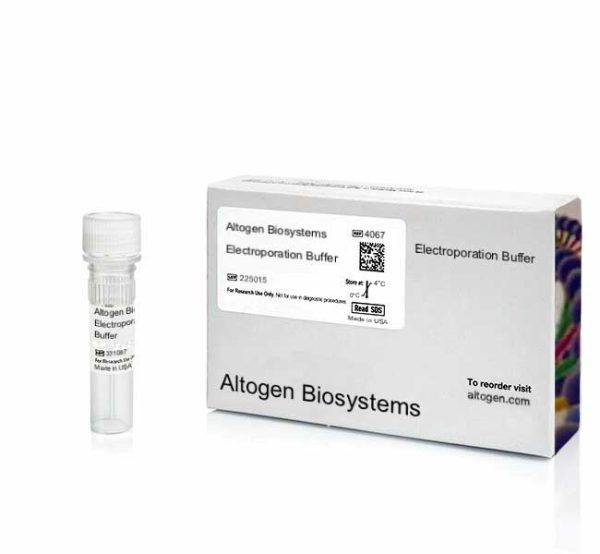
DNA Electroporation Buffer (30 ml)
Product Overview
DNA Electroporation Buffer is a sterile, low-conductivity solution designed to enhance the efficiency and viability of electroporation-based DNA delivery into mammalian, bacterial, yeast, and insect cells. This 30 ml formulation supports consistent high-yield transfection across a range of electroporation devices and experimental systems. Engineered to minimize arcing and thermal damage during pulsing, the buffer enables optimal electrical conductivity and membrane permeability for reproducible DNA uptake.
Electroporation is a non-viral transfection method that temporarily disrupts the phospholipid bilayer of the cell membrane using high-voltage pulses. This creates nanoscale pores through which plasmid DNA can enter the cytoplasm and, in mammalian cells, subsequently traffic to the nucleus. The performance of this process is critically dependent on the ionic composition and osmolarity of the electroporation buffer, making formulation selection a key factor in experimental success.
Optimized for High-Efficiency DNA Transfection
The DNA Electroporation Buffer is formulated with precise ionic balance and low conductivity to prevent dielectric breakdown and reduce cell death. Its formulation is optimized to maintain osmotic stability and protect cells from osmotic shock before and after the electroporation pulse. The buffer supports effective delivery of a wide range of DNA types, including plasmids, BACs, and linear DNA constructs, into adherent and suspension cells alike.
In particular, this buffer improves the electroporation performance in hard-to-transfect cell types such as primary cells, hematopoietic cells, stem cells, and certain immune cell populations. It enables consistent gene transfer in experimental setups ranging from single-cuvette electroporators to large-scale electroporation platforms used in therapeutic research and manufacturing.
Applications in Cell Engineering and Molecular Research
DNA electroporation is widely applied in genome editing, gene overexpression studies, CRISPR-Cas9 delivery, and generation of stable cell lines. This buffer facilitates the introduction of plasmid DNA constructs for short-term expression or for integration into the host genome via selectable markers or recombination systems.
The buffer is also compatible with co-electroporation experiments involving multiple plasmids, allowing simultaneous delivery of reporter, selection, or editing constructs. When used under optimized conditions, it supports rapid and uniform expression of transgenes, which can be quantified via fluorescence, qPCR, or functional protein assays.
Experimental Compatibility and Format
This 30 ml format is sufficient for dozens of electroporation reactions depending on cell type, DNA concentration, and cuvette volume. It is compatible with most standard electroporation instruments, including square-wave and exponential decay pulse generators. The buffer can be used with 1 mm or 2 mm gap cuvettes and has been validated for compatibility with electroporation of HEK293, CHO, HeLa, Jurkat, NIH-3T3, and primary cell lines.
The buffer is sterile-filtered and endotoxin-free, ensuring compatibility with sensitive applications, including therapeutic model development and preclinical gene transfer studies. It is supplied ready-to-use and should be pre-chilled and equilibrated to ensure maximum electroporation efficiency.
Critical Component for High-Fidelity Gene Delivery
DNA Electroporation Buffer is an essential reagent for laboratories using electroporation as a primary DNA delivery method. Its role in maintaining cellular viability while allowing precise control of transfection parameters makes it suitable for both basic research and advanced applications, including the development of transgenic models, adoptive cell therapy platforms, and ex vivo modification of patient-derived cells.
With the demand for non-viral, high-efficiency gene delivery systems continuing to grow, optimized electroporation buffers like this one are increasingly critical for reproducibility, scalability, and success across diverse fields of molecular biology and genetic engineering.
Read More Information: DNA Electroporation Buffer (30 ml)
Request Quote here: https://altogen.com/request-quote/